China’s Hypersonic Missile Arsenal Growth – What the Latest 2024 U.S. Assessment Reveals
China’s hypersonic missile arsenal is not a hypothetical threat; by current Pentagon projections, Beijing could deploy up to 4,000 hypersonic weapons—including the YJ-21, DF-17, and DF-21—by 2035. This rapid buildup shifts the regional balance by accelerating missile launch rates, overwhelming defense systems, and shrinking decision windows for the United States and its allies. As the U.S. defense community tracks every new test, satellite image, and production facility, one fact is impossible to ignore: the current pace of Chinese hypersonic missile development and fielding is unmatched, urging urgent improvements in U.S. response and missile defense strategy.
YJ-21, DF-17, and Chinese Hypersonic Missile Programs: Capabilities, Tests, and Deployment
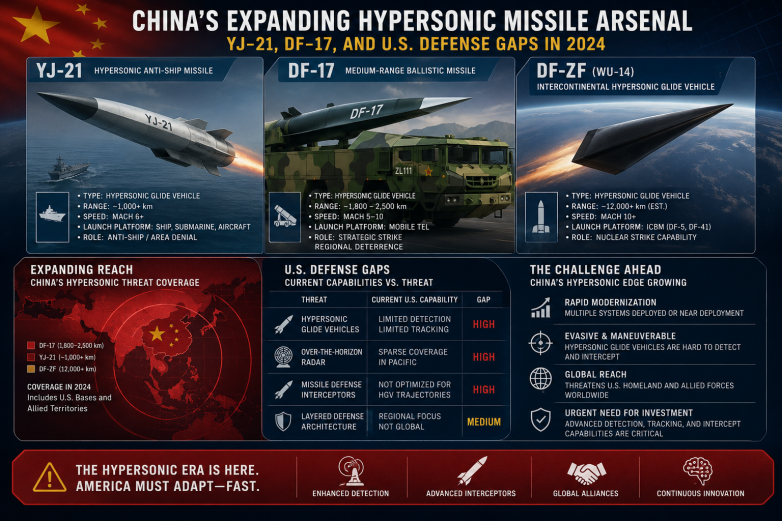
The YJ-21 is a highlight of China’s rapidly emerging hypersonic arsenal. Unveiled to international audiences in 2023 with dramatic test footage, this anti-ship ballistic missile can reportedly reach speeds exceeding Mach 10. The YJ-21 is not merely a showpiece—its deployment on PLA Navy Type 055 destroyers and other platforms signals China’s intent to field genuine ship-killing capabilities across the maritime theater (Jane’s Defence technical update, 2023).
The DF-17, employing a hypersonic glide vehicle, has been operational since 2020 and remains a key focus for defense analysts due to its demonstrated long-range strike ability. Chinese video clips from 2023 defense industry expos highlight advances in missile maneuverability, countermeasure resistance, and possible nuclear-armed configurations. In contrast, legacy systems such as the DF-21 and DF-26 continue to evolve, benefiting from ongoing low-cost mass production and extended ranges, making them well-suited for both regional and intercontinental strike missions.
China’s hypersonic program is distinguished by relentless field testing, vast production scalability, and methodical expansion into new deployment locations, including additional silos and mobile launch units. According to recent USNI News reporting, intelligence footage and Pentagon briefings have described new missile inventories and operational “stocks” of YJ-21 and DF-17 missiles rapidly accumulating across eastern and southern bases.
Range, Speed, Launch Systems: How Fast Can YJ-21, DF-17, and DF-26 Missiles Travel?
Hypersonic missiles are defined by their extraordinary velocity—typically above Mach 5, translating into speeds of at least 6,174 km/h. The YJ-21 and DF-17 both break this threshold, with Chinese sources claiming maximum speeds for the YJ-21 in excess of Mach 10 (12,360 km/h). The operational range of these systems is equally striking: the DF-17 is understood to deliver its glide vehicle over 2,500 km, while the DF-21 and DF-26 can reach distances of 1,500 km and up to 4,000 km, respectively.
Each system integrates a modernized launch architecture tailored for rapid employment in conflict. The YJ-21 is adaptable to surface-ship vertical launch cells, and the DF-17 is deployed via extensively road-mobile launcher units. By fielding hundreds—potentially thousands—of launch vehicles and silos, China ensures that hypersonic strike options can be delivered from a highly dispersed network, minimizing vulnerability to preemptive attack.
This focus on speed and launch resilience gives China a distinct military advantage in compressing U.S. interception windows: on a trajectory toward Taiwan or U.S. carrier strike groups, an incoming YJ-21 or DF-17 might allow only seconds to react, pressuring integrated air defense and command decisions to the breaking point (DoD 2023 China Military Report, p. 70).
Arsenal Growth, Production Tempo, and Inventory: Why Is the U.S. Falling Behind?
The current U.S. assessment underscores a stark production gap. China is fielding new hypersonic units at an unprecedented tempo, steadily building warhead and missile stockpiles. These inventories aren’t limited to a handful of elite systems; Chinese facilities produce a broad mix of missile types—from YJ and DF hypersonics to DF-21D anti-ship variants and the emerging YKJ-1000 platforms—supported by an industrial base organized for scalable, low-cost manufacture.
In contrast, U.S. hypersonic deployment lags behind both in the number of deployed launchers and in production output. While programs like the U.S. Army’s Dark Eagle and the Navy’s CPS (Conventional Prompt Strike) are progressing, they face technical hurdles, cost pressures, and serial delivery pacing that has not matched the speed at which China is churning out DF-17 and YJ-21 units. Defense News analysts warn this production mismatch could leave U.S. strike and naval forces at a strategic disadvantage if countermeasures do not ramp up accordingly.
Inventory growth is more than a number—it shapes real-time operational strategy. U.S. planners now model air and missile defense scenarios factoring in hundreds of simultaneous “arrivals” on fixed and mobile defense targets, challenging every radar, command, and kinetic interceptor platform in the Pacific sphere (USNI Technical Review, 2024).
Can U.S. Defenses Keep Pace? Interception, Navy Carriers, and the Limits of Countermeasures
The rise of Chinese hypersonic weapons directly threatens the security of U.S. and allied carrier strike groups, key bases such as Guam, and Taiwan itself. Most current U.S. missile defense systems—such as Aegis-equipped destroyers and land-based THAAD interceptors—were optimized for older ballistic or cruise missile profiles which give more reaction time. Hypersonic weapons, by contrast, combine high speed and unpredictable maneuverability, complicating timely detection, tracking, and interception.
U.S. missile defense modernization is underway, with investments in new radar arrays, faster data fusion, and next-gen hypersonic interceptors. Systems like the Glide Phase Interceptor (GPI) are in advanced development, but they are not yet operationally deployed across the theater. Naval platforms including Ford-class carriers must adapt to counter mass hypersonic salvos, prompting innovative tactics such as distributed fleet doctrine and enhanced electronic warfare support. Even the much-lauded Tomahawk cruise missile, JASSM, and submarine-launched options face relevancy questions under hypersonic threat conditions.
The ability to defend relies not just on hardware, but on speed of command and resilient operational tempo. If Chinese hypersonic rounds can be produced faster than U.S. countermeasures can scale, the defense gap widens, increasing risk of “inventory overmatch”—where the number of inbound weapons exceeds available interceptors or launch response options (
DoD 2023 China Military Report, pg. 108).
Strategic Implications: Inventory Math, Regional Security, and the Future of Missile Warfare
At bottom, the new era of missile arithmetic now dominates Asia-Pacific security planning. Instead of a battle limited by a few high-value warheads, the threat of thousands of Chinese hypersonic rounds—delivered by a mix of DF-17, YJ-21, and emerging types—compels all actors to rethink survivability, redundancy, and rapid response doctrine. Inventory size determines whether U.S. or allied defenses can absorb or repel a massed saturation attack.
Regional powers such as Taiwan, Japan, and South Korea have increased investments in early warning, counter-missile batteries, and command-and-control hardening specifically because of the Chinese hypersonic build-up. U.S. planners must anticipate new launch positions mapped out across southern and eastern China, prepare for the arrival of new hypersonic variants with deep penetration capability, and expect production numbers to climb year over year. The strategic calculus is shifting toward how many rounds each side can field and how quickly they can replace losses during a high-intensity conflict.
For every military and defense analyst tracking China’s hypersonic missile range, inventory, production rate, and the respective U.S. readiness, this contest has transformed strategy discussions into a race defined by physics, manufacturing efficiency, and operational math—an arena where speed, quantity, and resilience define the outcome.