B-21 Stealth Bomber Pivots to Two-Pilot Cockpit: Readiness and Replacement Strategy Explained
The US Air Force has confirmed its commitment to a two-pilot configuration for the entire B-21 Raider stealth bomber fleet. This operational doctrine is already shaping long-term training, sortie generation, and strategic planning across the service’s next-generation bomber inventory. The B-21, designed as the replacement for the aging B-2 Spirit and B-1B Lancer, must sustain a persistent mission tempo, and the two-pilot cockpit is key for ensuring crew coordination, system workload management, and the rapid turnarounds expected for modern long-range strike missions. Confirming the two-crew approach brings concrete guidance for how the B-21 will operate from day one, setting a new baseline for future bomber concepts and integrating lessons from decades of stealth platforms. This article examines how this seemingly simple crew design choice influences cockpit layout, operational tempo, and readiness, placing the B-21’s upcoming debut into sharp perspective compared to the aircraft it will replace.
Inside the B-21 Raider: Stealth Bomber Cockpit, Crew Structure, and Specs
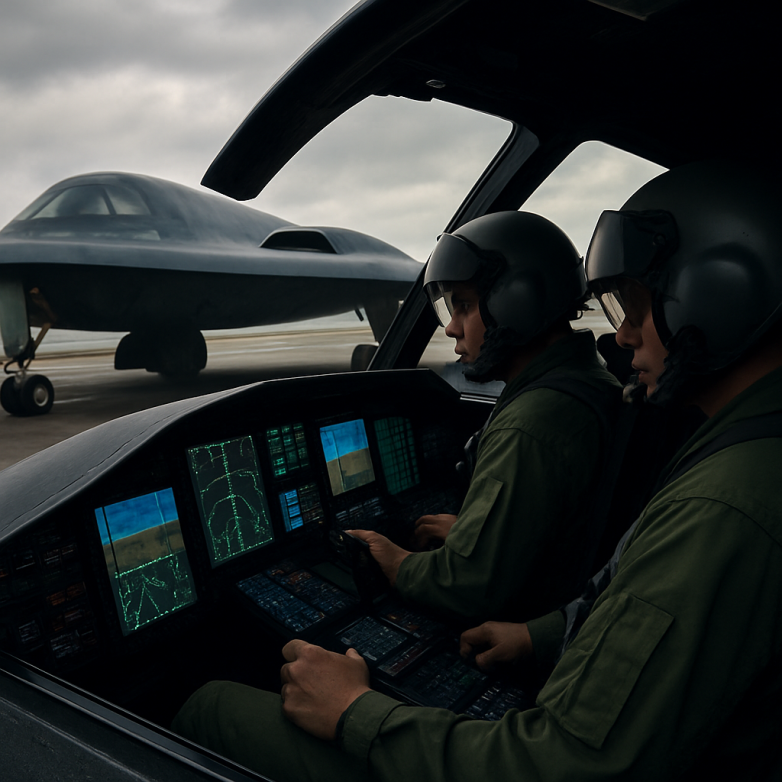
The B-21 Raider’s two-pilot cockpit is engineered for both workload distribution and mission survivability. With dual pilot positions, the B-21 enables continuous, around-the-clock operation on extended strike profiles, effectively balancing physical and cognitive demands during missions that can last more than 30 hours. Compared to the earlier single-seat stealth projects, this configuration directly responds to operational input from USAF crews—providing redundancy in high-threat environments and allowing for seamless task-sharing under stressful conditions (Air Force Magazine B-21 Update).
The new cockpit design is also deeply integrated with advanced avionics and display systems, with Northrop Grumman leveraging modular open-systems architecture to enable rapid upgrade cycles and adaptable controls. The two-crew concept isn’t simply a legacy decision; it reflects the complexity of multi-domain stealth operations, where managing arrays of sensors, electronic warfare suites, and flight management systems demands constant vigilance from more than one flight officer. This ergonomic philosophy anticipates not only today’s mission scope but future upgrades, including possible manned-unmanned teaming frameworks.
For comparison, the B-2 Spirit also relies on two pilots for similar reasons, though the B-21 advances this in a tighter, more efficient cockpit space to reduce radar cross-section and maintenance demands. Lockheed’s earlier F-117 Nighthawk, a single-seat platform, faced operational limitations in sortie rates and crew fatigue—a lesson not lost on the B-21 program. Having two pilots means faster mission cycles, better emergency response, and preservation of crew effectiveness during hours-long low-observable missions.
B-21 Range, Speed, Payload, and Refueling: Specs vs B-2 and Fleet Replacements
From a technical standpoint, the B-21 Raider’s specifications signal a significant evolution in US bomber capability. While precise figures remain classified, open reports indicate a comparable or improved range over the B-2, with estimates suggesting the B-21 will reach up to 9,600 kilometers (approx. 5,965 miles) unrefueled. The integration of advanced aerial refueling receptacles ensures global reach, allowing the B-21 to deliver its payload anywhere in the world (USAF B-21 Program Update).
Speed is believed to hover near high subsonic, approximating 1,030 km/h (640 mph)—matching or slightly exceeding the B-2’s mach 0.85 cruising profile. Payload is another area where the B-21 outpaces comparable bombers, with modular internal bays designed to handle both conventional and nuclear ordnance. While its exact maximum weapon carriage is yet to be disclosed, early statements suggest it will match the B-2’s 18,000 kg (40,000 lb) class capability, if not surpass it, all while optimizing internal arrangement for stealth and flexibility.
The B-21’s radar cross section is designed to be even smaller than the already-stellar B-2, leveraging next-generation shaping, coatings, and materials. Compared to its predecessors, the Raider offers smaller size and lower operating costs per flight hour, with anticipated unit price projections in the $550-$700 million range—about half the current cost of fielding the B-2 Spirit. These factors all contribute to the B-21’s selection as the B-2, B-1, and ultimately B-52 replacement in the USAF’s future manned bomber fleet.
B-21 Raider vs B-2 Spirit: Cockpit, Cost, and System Integration
The comparison between the B-21 Raider and its predecessor, the B-2 Spirit, comes down to technological efficiency and operational philosophy. The B-21 not only builds upon the basic two-pilot setup of the B-2 but does so with streamlined controls and digital interfaces, reducing crew distraction while maximizing mission focus. Technicians and operators working with the B-2’s complex maintenance and support system inspired the B-21’s push for modularity and ease of subsystem access.
On cost, the B-21 is projected to be significantly more sustainable, both in acquisition and lifecycle expenses. The B-2’s $2 billion per-aircraft estimate and high hourly flight expense drove efforts to make its successor more affordable and easier to maintain. By utilizing digital engineering throughout its production, Northrop Grumman expects the B-21 to stay within established budgetary constraints and avoid the performance-cost spirals that afflicted previous platforms (Defense News: B-21 Raider Development).
Both aircraft are invisible to most radar, but the B-21 advances the cause further with contemporary low-observable techniques, reduced surface joints, and a far cleaner electronic baseline. The cockpit layout, in concert with the aircraft’s physical design, supports the fusion of stealth, survivability, and operational tempo—a necessity as the bomber assumes greater roles in a peer conflict environment and stands ready for rapid global deployment.
B-21 Raider Fleet: Production, Replacement Timeline, and Operational Manned Doctrine
The B-21 program is central to replacing the US Air Force’s aging bomber arsenal. The current plan calls for at least 100 B-21 Raiders, though Air Force officials have hinted that the final number could be substantially higher as strategic needs evolve and the service phases out the B-1 and B-2 over the next two decades. Production is scaling through incremental blocks, with initial capability aimed for the mid-2020s; broader operational availability is expected by 2027 or soon after. This aggressive timeline responds to global security demands and the urgency of maintaining strategic deterrence with state-of-the-art hardware.
Transitioning to an operational manned doctrine, the two-pilot structure ensures that B-21 crews can be trained more rapidly and flexibly than past stealth bomber generations. This enables a robust pipeline of qualified crews, mitigating bottlenecks in pilot production and maintaining fleet readiness as new aircraft arrive at operational units. The manned B-21 also provides a “human in the loop” safeguard for both nuclear and conventional missions, preserving decision authority and adaptability in the most complex threat scenarios.
Replacement of the B-2 and B-1 hinges not just on airframe performance but on sustainable operations tempo. The two-pilot B-21 cockpit is at the heart of this shift—optimizing every sortie and extending strategic reach without sacrificing mission integrity, safety, or adaptability, a crucial enabler for twenty-first-century airpower projection.
B-21 Cockpit Design, Pictures, and Interior: What Does the Raider Look Like?
Although most design specifics and cockpit photos of the B-21 remain classified—security and industrial secrecy are paramount—a handful of USAF-released renderings confirm that the interior will feature state-of-the-art digital displays, panoramic situational awareness, and streamlined controls. Unlike the sprawling dashboards of Cold War bombers, the B-21’s interface minimizes distractions and maximizes focus on stealth operations, threat detection, and networked warfare requirements.
Analysis of the available pictures and computer-generated images reveals a tighter, more ergonomically efficient crew environment than the B-2 or B-52 platforms. The seating arrangement and flight controls highlight a “glass cockpit” approach, with multifunction screens replacing analog dials and switches. This evolution makes it easier for pilots to manage every system from environmental controls to mission planning, without breaking stealth protocols or compromising mission security. Though pilots will physically inhabit a compact compartment, it is engineered for maximum vigilance and comfort during long-endurance flights.
As the B-21 Raider nears public rollout and initial deliveries, additional interior details and verified cockpit images are anticipated to surface via official defense sources and staged static displays. Until then, the available schematics and curated images—backed by US Air Force program briefings—indicate a leap beyond traditional bomber layouts, embodying the twin priorities of crew survivability and mission endurance that define the B-21’s core operational concept.
B-21 Raider Future: Engines, Specs, and the Path to Operational Service
The B-21 Raider’s propulsion system is one of the most tightly guarded technologies in the program, though it is confirmed to use advanced, fuel-efficient engines derived from previous stealth and strike aircraft powerplants. The emphasis is on minimizing IR and radar signatures while ensuring sufficient thrust for high-subsonic speeds and global-range performance. Integration of these engines is optimized for both performance and maintainability, reflecting lessons learned from decades of bomber operations and sustainment challenges.
All indicators point to a platform designed not just for stealth and agility, but for adaptability. The B-21’s modular hardware enables rapid upgrades, whether in electronic attack, advanced munitions carriage, or even potential future unmanned modes. This flexible approach will allow the Air Force to keep the B-21 relevant and ahead of emerging threats well into the 2050s and beyond—a long service life compared to earlier platforms.
As the B-21 Raider enters the final phases before operational service, it stands as a benchmark in both strategic deterrence and adaptable airpower. With the pending transition from legacy bombers to this new breed, the two-pilot cockpit—supported by innovation in stealth, mission systems, and sustainment—anchors the Raider as the backbone of US bomber capabilities for the foreseeable future.
The B-21 marks a generational leap in replacement strategy, system integration, and operational logic—ensuring the US Air Force sustains decisive reach and readiness in the decades ahead.